Why Content Is the #1 Growth Lever for Electricians
The ones making the most money aren't the ones with the slickest ads or biggest budgets. They're the ones with a content system that works while they sleep.
According to HubSpot's 2025 State of Marketing Report, 72% of electricians say content marketing generates qualified leads at a lower cost than traditional advertising. Yet most are still just relying on their Google Business Profile and occasional ad spend.
The contrarian take? You probably don't need more reviews. What you need is content that shows Google you're an authority. Content: (1) builds trust before the first phone call, (2) captures high-intent searchers ready to hire (3-5x higher conversion), and (3) creates a lasting asset that compounds for years instead of disappearing in 7 days.
You don't need to be a writer. You need a system. Let me walk you through it.
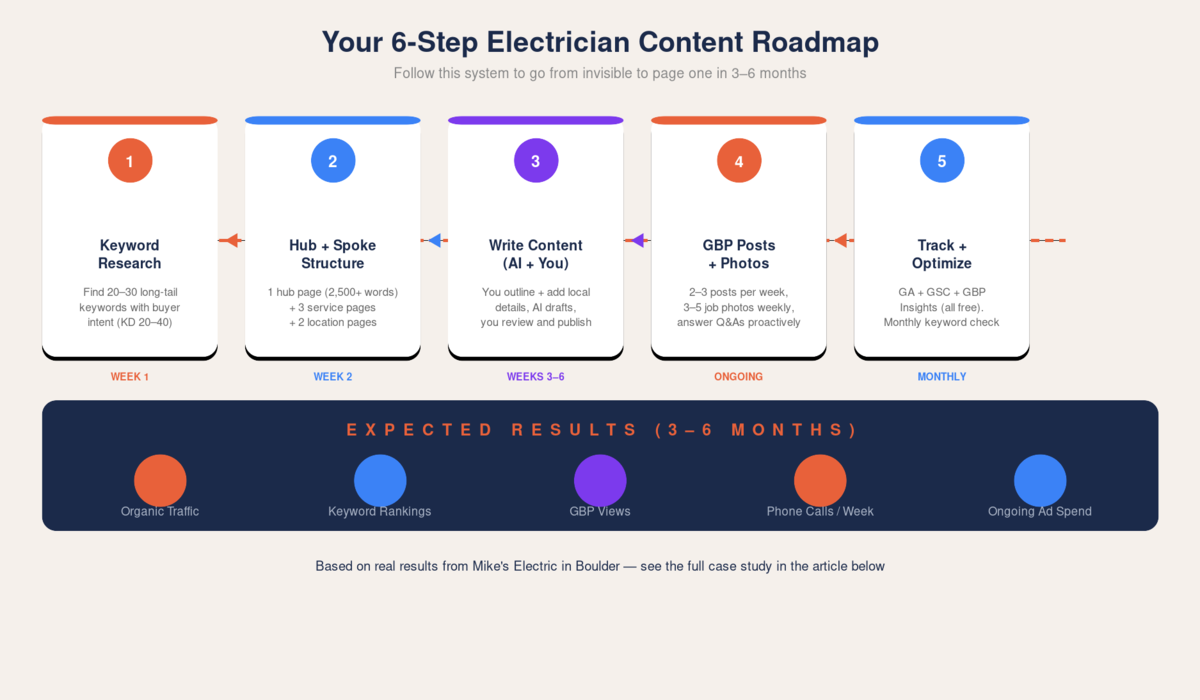
Your complete content strategy roadmap — follow these 5 steps to go from invisible to page one
Finding the Right Keywords
If you're just getting started, the single biggest mistake is going after broad keywords like "electrician" or "electrical services." Those terms have massive competition — national directories, franchise chains, and sites with years of authority already own page one. You won't outrank them anytime soon, and you'll burn months with nothing to show for it.
Instead, start with long-tail keywords — longer, more specific phrases that fewer businesses are targeting. These are your entry point.
Why Long-Tail Keywords Work for Beginners
A long-tail keyword is typically 4-7 words and describes exactly what someone needs. Compare these two searches:
- "electrician seo" — thousands of monthly searches, but you're competing against massive SEO agencies, national directories like Yelp and Angi, and marketing companies that have been building authority for years. You're not going to outrank them as a local electrician.
- "panel upgrade cost in Atlanta" — maybe 150 monthly searches, but the only competition is other local electricians. Much easier to rank for, and every person searching this is a potential customer in your area.
The second keyword has far fewer searches, but that's the point. Fewer searches means fewer big brands competing for it. The people searching are local, they need the service now, and there's room for you on page one. These long-tail keywords convert 3-5x better because you're reaching people ready to hire — not competing with national brands for generic traffic.
Think of it this way: would you rather fight Yelp, Angi, and HomeAdvisor for a generic term, or rank on page one for a specific service in your city where the competition is just a handful of other local electricians?
How to Find Long-Tail Keywords (Free Methods)
You don't need expensive tools to get started. Here are four free ways to find keywords worth targeting:
1. Google Autocomplete — Start typing a service into Google and see what it suggests. Type "electrician panel upgrade" and Google will show you what people actually search for: "electrician panel upgrade cost," "electrician panel upgrade 100 to 200 amp," etc. Each suggestion is a real keyword.
2. "People Also Ask" boxes — Search for any electrician-related term and look at the expandable questions Google shows. These are gold — each one is a question real customers are asking, and each one can become a blog post or FAQ answer.
3. Your own call logs — Look at the last 20 calls or messages you received. What did customers ask about? "Do I need a permit for..." or "How long does it take to..." — these are keyword ideas straight from your market.
4. Competitor websites — Visit the websites of 3-4 electricians ranking on page one in your area. Look at their blog titles, service page headings, and FAQ sections. If they're writing about it, there's probably search demand behind it.
Evaluating Which Keywords to Target First
Not all long-tail keywords are worth your time. Use this framework to pick the right ones:
| Factor | What to Look For | Why It Matters |
|---|---|---|
| Competition | Search the keyword — if page one is mostly local businesses, you can compete. If it's dominated by Yelp, Angi, and national brands, skip it for now. | Less competition = faster path to page one |
| Monthly search volume | 50-300 searches/month is the sweet spot | Enough traffic to matter, not so much that big players dominate |
| Search intent | Words like "cost," "how much," "near me," "signs," "vs" | These signal someone ready to take action, not just researching |
| Relevance | Services you actually offer in areas you actually serve | Don't write about EV chargers if you don't install them |
Your First 10 Keywords
As a starting point, aim for 10 keywords that check all four boxes above. Here's what a strong starter list looks like for an electrician:
| # | Keyword | Type | Intent |
|---|---|---|---|
| 1 | "electrical panel upgrade cost" | Cost | Ready to buy |
| 2 | "how much does it cost to rewire a house" | Cost | Ready to buy |
| 3 | "EV charger installation cost" | Cost | Ready to buy |
| 4 | "signs you need to rewire your house" | Signs | Problem-aware |
| 5 | "signs of outdated electrical wiring" | Signs | Problem-aware |
| 6 | "flickering lights in house dangerous" | Signs | Problem-aware |
| 7 | "panel upgrade vs panel replacement" | Comparison | Evaluating |
| 8 | "GFCI vs AFCI outlets" | Comparison | Evaluating |
| 9 | "electrician near me for panel upgrade" | Local | Ready to hire |
| 10 | "residential electrician Peachtree Atlanta" | Local | Ready to hire |
Notice the mix: 3 cost keywords (highest buying intent), 3 "signs" keywords (problem-aware customers who convert well), 2 comparison keywords (people evaluating options), and 2 local keywords (ready to hire right now). That gives you enough content to build real topical authority without spreading yourself too thin.
Don't try to rank for everything at once. Pick your top 10 long-tail keywords, write great content for those first, and expand from there. Most electricians who try to target 50 keywords from day one end up with 50 mediocre pages instead of 10 strong ones.
Start with long-tail, low-competition keywords (KD under 20, 50-300 monthly searches) that match services you actually offer. Find 10-15 to start, write content for those, then expand as you gain authority. Use free tools — Google Autocomplete, People Also Ask, your call logs, and competitor sites — to build your initial keyword list.
Website Content Structure: The Hub-and-Spoke Model
The most effective structure follows a hub-and-spoke pattern: a main authority page (hub) with supporting pages (spokes) linking back to it. Why this works: Google sees you as an expert on the entire category, internal links pass ranking power, visitors explore related topics without leaving your site, and more pages explored = better ranking signals.
Example structure:
- Hub page: "Bryco Electric's Complete Guide to Residential Electrical Services in Peachtree Atlanta" (2,500-3,500 words)
- Spoke pages: "EV Charger Installation Costs in Peachtree Atlanta," "When You Need a Panel Upgrade," "Signs Your Wiring Is Outdated" (1,200 words each)
See our Complete Guide to Electrician SEO for the full framework.
Build these pages first: (1) Service pages — one per major service answering What/Cost/When/Process, include photos and CTA; (2) Location pages — one per city, with neighborhoods, codes, Google Map, and phone number; (3) Blog posts — long-tail traffic targeting "How much does [service] cost," "Signs you need [service]," etc.
Start with 3 service + 2 location + 1 hub page. Get those ranking first, then expand. Keep URLs clean and keyword-focused (e.g., yoursite.com/services/panel-upgrades, yoursite.com/denver-electrician).
Content Best Practices
Write for humans first — clear, practical, no jargon. Answer immediately: if someone searches "how much does a 200-amp panel upgrade cost," lead with the price. Include specific details: market-specific pricing ($2,100-$3,800 in Atlanta), timeframes ("8-10 hours"), local codes, and real experience.
Backlinko's 2025 research shows pages with images get 94% more views. Include before/after photos and diagrams. Every page needs one obvious next step: a call button, contact form, or "Schedule your free inspection" CTA.
Specific, action-oriented content with a clear path to contact you. Lead with the answer, back it up with local details, and always include a next step.
Google Business Profile Content Strategy
Your GBP is a second content platform that directly impacts visibility in the Map Pack. I've watched electricians get 30-40% of their calls from consistent GBP activity alone.
Post service highlights and seasonal tips at least once per week (older posts disappear after 7 days; 2-3 per week is ideal). Include before/after job photos, limited-time offers, and proactive Q&A answers to control the narrative.
Upload 3-5 new photos weekly — take a photo of each completed job before leaving, caption it, and over 6-12 months you've built a portfolio of 150-250 real photos that builds trust and pushes your listing higher in the Map Pack.
GBP posts take 10 minutes each. Do 2-3 per week and watch leads increase. Consistency beats perfection — a quick phone photo with a caption outperforms no post at all.
Using AI to Scale Your Content
The biggest bottleneck for electricians building content is time. AI excels at drafting blog posts from an outline you write, generating GBP post angles, creating FAQ sections, and repurposing content. But AI can't replace your market pricing (it hallucinates numbers), local specifics (neighborhood names, permit costs, codes), real project stories, or photos of your work.
You provide the foundation (outline, pricing, local info, project details, keywords) → AI drafts the content → You refine it (fact-check, add your voice, verify numbers, add photos) → Publish and monitor. This gives you AI's speed with your authority.
Generate 4 weeks of GBP posts in 30 minutes: create a spreadsheet (service | season | offer), prompt AI to generate posts, review and add specifics, then schedule. That's compounding content with minimal effort.
Use AI for drafting and structure. You provide the expertise, pricing, and local knowledge that makes content convert.
Tracking Your Content Performance
Publishing content and hoping it works is flying blind. Measure what matters:
- Organic traffic: Google Analytics shows search traffic. Track monthly trends — are you up vs. last month?
- Keyword rankings: Google Search Console shows where target keywords rank. Track 5-10 primary keywords monthly.
- GBP activity: GBP Insights shows views, calls, direction requests. If you post 2x weekly and views increase, you're winning.
- Lead generation: Track phone calls, form submissions, appointment requests — this is the actual result. Track which content pieces drive most leads.
You don't need expensive tools. Google Analytics (free), Google Search Console (free), and GBP Insights (free) tell you everything you need to know. Set up all three before publishing your first piece of content.
Real Example: Bryco Electric in Peachtree Atlanta
The Setup: Bryco Electric — licensed, insured, good reputation in Peachtree Atlanta, but only 2-3 calls per week from existing customers.
The Action: Using ServiceGo's automated keyword analysis, Bryco discovered 3 services and 60 related keywords that none of their neighborhood competitors were targeting. Bryco built a hub page (2,800 words), created 3 spoke pages (1,200 words each), posted to GBP 2x weekly, and added 50+ job photos.
The Results (4 months later):
- Organic traffic: 15 → 240 visits/month (1,600% increase)
- 3 target keywords in top 5
- GBP views: 30/week → 210/week
- Phone calls: 2-3/week → 8-10/week
- New revenue: $12,000+ in first 4 months
Bryco followed the system: smart keywords, hub-and-spoke structure, consistent GBP activity, tracking results. You can replicate this. The compound effect kicks in after 3-4 months.
How ServiceGo Helps
ServiceGo offers automated keyword analysis (data-driven opportunities for your market), quick-win identification (keywords you can realistically rank for in 3-6 months), DIY guidance (step-by-step recommendations), and done-for-you optimization (implementation + hub-and-spoke structure). ServiceGo specializes in local SEO for small to medium home service businesses.
If you want to do this yourself, grab your free audit and get started. If you'd rather have someone handle the setup, ServiceGo could do that as well.
Frequently Asked Questions
Most electricians see meaningful movement (ranking improvements, increased organic traffic) within 3-4 months of consistent publishing. By month 4, with 8-12 pieces targeting different keywords, expect 20-40% increases in organic traffic. SEO compounds over time — you're building authority, not buying instant visibility.
No. Add your hub pages and spoke pages on top of your existing structure. Just ensure outdated service pages aren't full of old pricing or incorrect information. The key is clear internal linking between your hub and spokes so Google understands the relationships.
You can absolutely do it yourself — follow content best practices, nail your internal linking between hub and spoke pages, and add the local details that only you know (your service area, pricing, real job stories). Tools like ServiceGo's DIY plan give you keyword research, content briefs, and SEO scoring so you publish with confidence. If you'd rather focus on running jobs, ServiceGo's Done For You service handles everything from keyword research, content strategy and publishing — optimized content written specifically for your service area and specialties.
Google Ads costs $3-8 per click and requires ongoing spend. Local SEO requires upfront effort but costs near-zero afterward. Over 12 months, good content generates 100+ qualified leads at near-zero cost. Both work — successful electricians use both: ads for short-term quick wins, content for long-term compounding leads.